

VilCart connects villages to primary markets by ensuring simple, accessible delivery of essentials to every doorstep
We aim for sustainable growth by consolidating our presence in South India over the next three years, says Prasanna Kumar C, Founder & CEO of Vilcart
Prasanna Kumar C, Founder & CEO, Vilcart
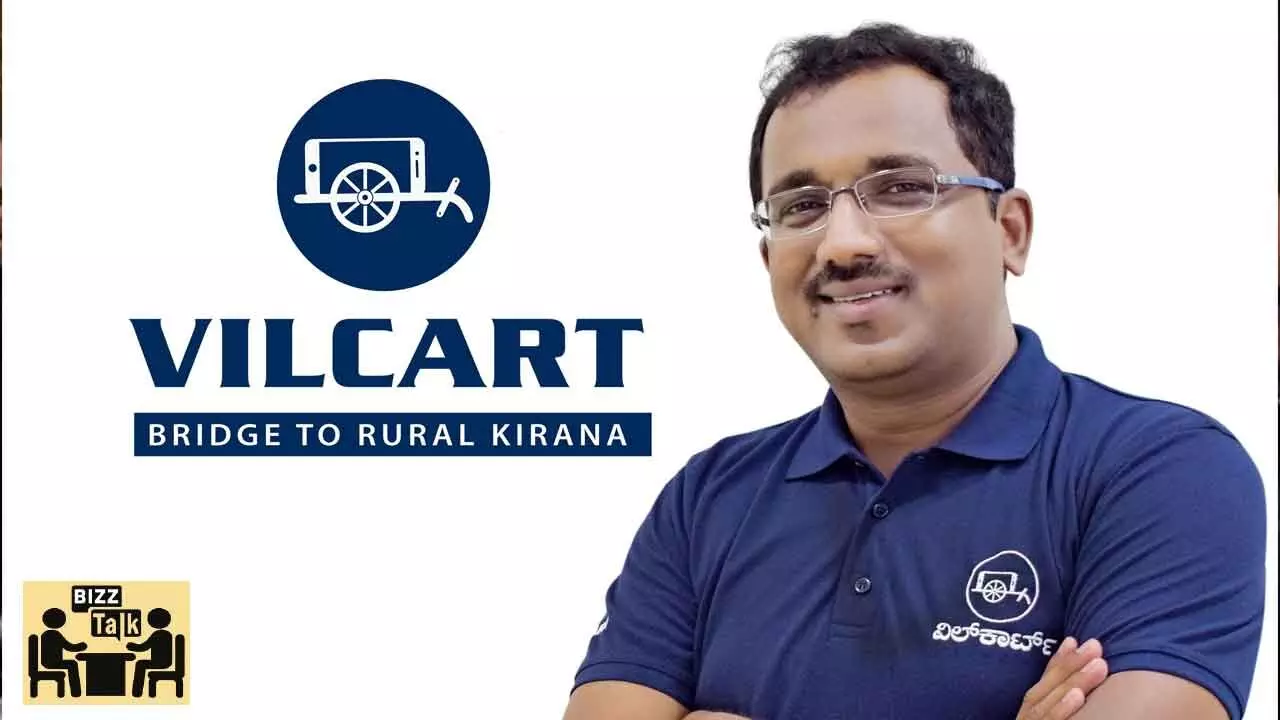
Prasanna Kumar C, Founder & CEO, VilCart, India's trailblazing rural commerce platform, discusses the seismic shift in rural e-commerce, where kirana stores are reclaiming the "quick commerce" crown with hyper-local innovation.
“VilCart enables local and rural brands to scale through its extensive network and private labels across categories such as edible oils, staples, masalas, cleaning agents, snacks, stationery and other FMCG goods,” Prasanna Kumar said in an interview to Bizz Buzz.
“By creating a strong pipeline between villages and primary markets, VilCart streamlines sourcing, logistics and distribution to ensure consistent availability of high-quality products at the best prices for rural households.”
What is the rationale behind the formation of VilCart and the name?
Growing up in Mandya, Karnataka, in a rural agrarian family, I witnessed firsthand how fragmented supply chains left small kirana stores; the lifelines of villages, struggling with procurement losses and limited access to quality goods.
In 2018, after years as a Chartered Accountant advising startups, I founded VilCart to build a dedicated, rural-exclusive ecosystem - a tech-enabled bridge connecting Farmer Producer Organisations (FPOs), SMEs and manufacturers directly to kirana outlets.
By creating a strong pipeline between villages and primary markets, VilCart streamlines sourcing, logistics and distribution to ensure consistent availability of high-quality products at the best prices for rural households.
VilCart also enables local and rural brands to scale through its extensive network and private labels across categories such as edible oils, staples, masalas, cleaning agents, snacks, stationery and other FMCG goods.
Today, VilCart empowers over 100,000 kirana stores across 30,000 villages in South India, ensuring affordable and reliable essentials for nearly 900 million rural Indians
The name “VilCart” reflects this vision; a fusion of “village” and “cart,” symbolising a simple, accessible bridge (like a rural cart) that efficiently transports essentials from primary markets to every doorstep, transforming isolated villages into connected “Grameena Super Markets.”
What do you attribute to the growth of VilCart?
VilCart’s growth, from a single district in Karnataka in 2018 to a projected $140.5 million in FY25 revenue (up 26% YoY) can be attributed to its hyper-local approach focused on solving real rural pain points. We streamline B2B supply chains for kirana stores, expand private labels (currently 18% of sales, targeting 50% in 3–5 years), and leverage our B2C app, launched in November 2025, which has already achieved 15,000+ downloads through grassroots campaigns such as 1001 Women App Champions.
Key enablers of this growth include $31.3 million in funding (latest: $10M bridge in February 2025 from AI-X BV and Spark Capital), an EV-fleet logistics network enabling three-day delivery to villages, and data-driven SKU optimisation; all capturing the $100B rural e-commerce opportunity projected by 2026.
Are you planning to expand pan-India?
Absolutely, but with a measured stability. Over the next 1-2 years, our focus is on consolidating in South India - Karnataka, Andhra Pradesh, Tamil Nadu, Telangana, and Kerala, where we have invested over five years in building infrastructure, technology, and language localization.
Currently, we cover only about 50% of Karnataka and 20% of Andhra Pradesh. Beyond this phase, we will explore expansion into North and Western India with adapted models, such as region-specific logistics strategies. Given the vast and scattered nature of the rural market, spanning 93% of India’s geography and 68% of its population; success depends on localised execution rather than aggressive pan-India expansion.
This phased approach ensures profitability before broader scaling, intending to become the leading rural commerce player in South India by 2027.
Do you find the rural market tech-savvy enough to embrace e-commerce?
Yes, rural India is digitally primed. Smartphones are now a household necessity rather than a luxury, and the rollout of 5G has enabled seamless access to OTT platforms and social media, fostering tech literacy and aspirations comparable to urban peers.
We’ve seen this reflected in the early traction of our B2C app, with over 10,000 plus downloads since its November launch. A Kannada-first user experience, combined with strong kirana trust, has helped overcome barriers such as cash preference, which still account for nearly 80% of transactions. With uninterrupted access shaping evolving needs, the 900 million rural consumers are ready for e-commerce. it is the supply chain that must now rise to meet their expectations.
How big is the market in terms of kirana stores, and how many have you covered?
India’s kirana ecosystem is enormous, with approximately 13-15 million stores handling 80-92.6% of FMCG sales (down from 95% in 2018 and projected at 88.9% by 2028 due to the rise of quick commerce). VilCart has digitized over 100,000 kirana stores across 30,000+ villages in South India. While this represents only about 1% of the national total, it captures a dominant share within our hyper-local focus, enabling three-day deliveries to small, previously untapped villages that lack brand networks.
Do you have any other products or services in the pipeline?
Yes, we’re aggressively scaling our electronics and home appliances marketplace, launched via our B2C app, initially targeting Karnataka and then expanding across South India. We’ve spent three years experimenting to align with rural aspirations, offering products from cookers to induction stoves, all fulfilled through kirana partners to ensure seamless after-sales support.
Our private labels are also expanding, covering edible oils, biscuits, noodles, cereals, and masalas; which already account for 18% of sales. Next on the roadmap are deeper integrations with FPOs for fresh produce and potential SHG-linked credit services to empower women entrepreneurs.
Will your e-commerce operations disrupt the market, especially in terms of employment?
Far from disrupting the market, our model strengthens it. Kirana stores remain central; serving around 50 families each as trusted community hubs, and act as our delivery, collection, and after-sales partners.
Through digitization and initiatives like the 1001 Women App Champions program, which has supported 1,000+ micro-ventures, we’ve already generated thousands of livelihoods for youth and women. This is collaborative growth, not replacement, fostering stability across India’s scattered rural supply chains.
What are your growth plans for the next three years?
Over the next three years, VilCart aims to achieve sustainable growth and profitability by consolidating our presence in South India, optimizing our supply chain and technology infrastructure, and expanding our product and service offerings.
We will continue deepening engagement with kirana stores, FPOs, and rural consumers, while strengthening our private labels and exploring new value-added services. Our goal is to build a scalable, resilient model that drives long-term impact and value across rural India.
Is there room for taking your services internationally?
Our immediate mission is to conquer the rural supply chain complexity here in India. However, the VilCart model, built on the pillars of trust, hyper-localization and efficiency, is globally relevant. We view our success here as developing an exportable blueprint for digital rural commerce.
While our feet are firmly planted in the Indian villages today, our vision is to solve the rural retail puzzle for the entire developing world tomorrow.
What are the marketing efforts and how you plan to create awareness about your business?
The VilCart marketing playbook starts and finishes with the trust we have built at the ground level. We are strategically focused on converting the immense reach of our existing B2B network - a proven supply chain - into the most dependable channel for B2C digital adoption.
This conversion is powered by dedicated Village Level Entrepreneur (VLE) support, targeted in-store activations and highly relevant vernacular content that speaks directly to the heart of the village consumer.





